India’s projects
- Fleet Expansion and Replacement:
- India aims to acquire ~700 new commercial ships (200 ocean-going and 500 coastal/inland vessels) by 2047 to replace aging vessels and meet growing trade demands. This aligns with the Maritime India Vision 2030, which targets a top-10 global shipbuilding rank for India.
- The recent launch of Bharat Container Shipping Line (BCSL) under the Shipping Corporation of India (SCI) will manage a new fleet of large container vessels to address India’s low containerization rate (currently <30%). These vessels will be acquired via leases or purchases.
- Green Shipping and Sustainability:
- India is investing in green hydrogen-powered vessels and infrastructure, including:
- Three Green Hydrogen Hub Ports at Kandla, Paradip, and Tuticorin to support low-emission maritime operations.
- A 1-MW green hydrogen plant at Deendayal Port (Kandla), with plans to scale to 10 MW.
- The Shipbuilding Financial Assistance Policy (SBFAP 2.0) offers up to 30% subsidiesfor vessels powered by green hydrogen, ammonia, methanol, or electricity.
- India is investing in green hydrogen-powered vessels and infrastructure, including:
- Infrastructure and Digitalization:
- Port modernization efforts include digitizing operations via platforms like:
- One Nation-One Port Process (ONOP) for standardized operations.
- National Logistics Portal (Marine) for cargo tracking.
- MAITRI Virtual Trade Corridor, designed to virtually integrate ports, customs, and trade hubs to expedite cross-border trade
- The Sagarmala Programme: 839 projects worthinvestment of ~Rs. 5.8 lakh Cr. for implementation by 2035. Focuses on port modernization, coastal shipping, and logistics efficiency.
- Port modernization efforts include digitizing operations via platforms like:
- International Collaborations:
- Partnerships with Norway, Denmark, and Japan for technology transfer, ice-class vessel design, and smart port initiatives.
- Joint feasibility studies with Norway for Arctic shipping routes and design of India’s first Polar Research Vessel (PRV).
Joint India-Russia (civil) projects
- Northern Sea Route (NSR) Development:
- Jointly exploring the NSR to reduce transit time between Asia and Europe (e.g., NSR cuts Shanghai-Rotterdam distance by 22% and cost by 30-40%).
- Rosatom is partnering with Indian shipyards to build four non-nuclear icebreakers (cost: $713 million) for NSR operations. These vessels will facilitate year-round navigation along Russia’s Arctic coast.
- India also pushing for its seafarers to get training in polar waters.
- Chennai-Vladivostok Sea Route aka Eastern Maritime Corridor (EMC):
- Thecorridor (5,600 nautical miles) leverages the NSR for part of its journey; tailored to connect India’s eastern coast with Russia’s Pacific port; to reduce India-Europe travel time by two weeks. It became operational in 2024, carrying oil, food, and machinery.
- Documentary Framework
The two countries signed the Program of India-Russia cooperation in trade, economic and investment spheres in the Russian Far East for the period from 2024 to 2029 as well as of cooperation principles in the Arctic zone of the Russian Federation
Russia’s projects
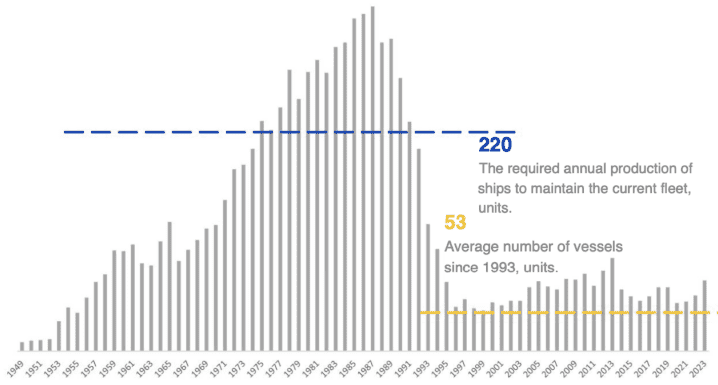
Russia’s shipbuilding capacity 1949-2023
- Fleet Expansion Goals and Targets
- Russia aims to build1,637 civilian ships by 2036, backed by a federal funding allocation of 500 billion rubles (approximately $6 billion). This includes:
- 713 vessels scheduled for construction between 2025 and 2030.
- A subsequent target of 2,634 ships between 2037 and 2050.
- The planned fleet composition includes:
- 251 river-sea class transport ships
- 122 vessels for regular sea transport
- 51 ships specifically for the Northern Sea Route
- 541 auxiliary and service vessels
- 18 icebreakers by 2036
- Focus on Arctic Shipping and the Northern Sea Route (NSR)
- A key priority is supporting shipping along the Northern Sea Route (NSR) and the North-South Transport Corridor. The strategy emphasizes the construction of 130 high ice-class vessels, including oil and gas tankers, bulk carriers, and container ships, to enhance Arctic operations.
- The NSR is viewed as a strategic alternative to traditional routes like the Suez Canal, potentially reducing distances between Asia and Europe by 22% and cutting transportation costs by 30-40%.
- Russia plans to increase its icebreaker fleet from 45 vessels (as of 2023) to 60 by 2030 and 69 by 2036.
- Challenges and Setbacks
- Budget Cuts and Scaling Back: Due to mounting war costs and falling revenues, Russia has scaled back its civilian fleet modernization program. Funding has been cut by more than 40% (from $2.88 billion to $1.68 billion), and the number of planned new vessels has been reduced from 260 to 191 by 2027.
- Aging Fleet: The average age of a Russian civilian vessel is 40 years, and the country requires 200-220 new ships annually just to maintain operational safety and reliability. The cuts risk further accelerating the fleet’s decay.
- Sanctions and Supply Chain Issues: Western sanctions have severely impacted Russia’s access to foreign shipbuilding technologies and components. Notably, 97% of all imported equipment was previously purchased from “unfriendly countries”. This has disrupted projects like the construction of Arc7 gas carriers and Arc6 crude oil tankers.
- Domestic Capacity Limitations: Russia lacks suitable facilities for constructing large-tonnage ships. Only a few shipyards can build civilian vessels longer than 170 meters.
- Emphasis on Self-Sufficiency and Domestic Production
- The strategy aims to increase the domestic production of ship components to 50% by 2036 and 80% by 2050.
- Goals include raising the share of civilian products within the shipbuilding sector to 61% by 2036 and 64% by 2050, reducing dependency on military orders.
- Efforts involve building new shipyards, expanding existing facilities, modernizing ship repair centers, and advancing research and development (R&D).
Featured image by Ian Taylor on Unsplash